Rice Lake Terrace — Five-Year Financial Comparison (2027–2031)
“Adding $10,000 a year plus additional expenses in 2026 for groundskeeping expenses has eliminated any possibility of avoiding a 10% increase, we now have a guaranteed increase for the next 5 years, the only way to lessen it, is to cut costs drastically by eliminating the Management Company. Any additional costs will cause an assessment.” - Travis
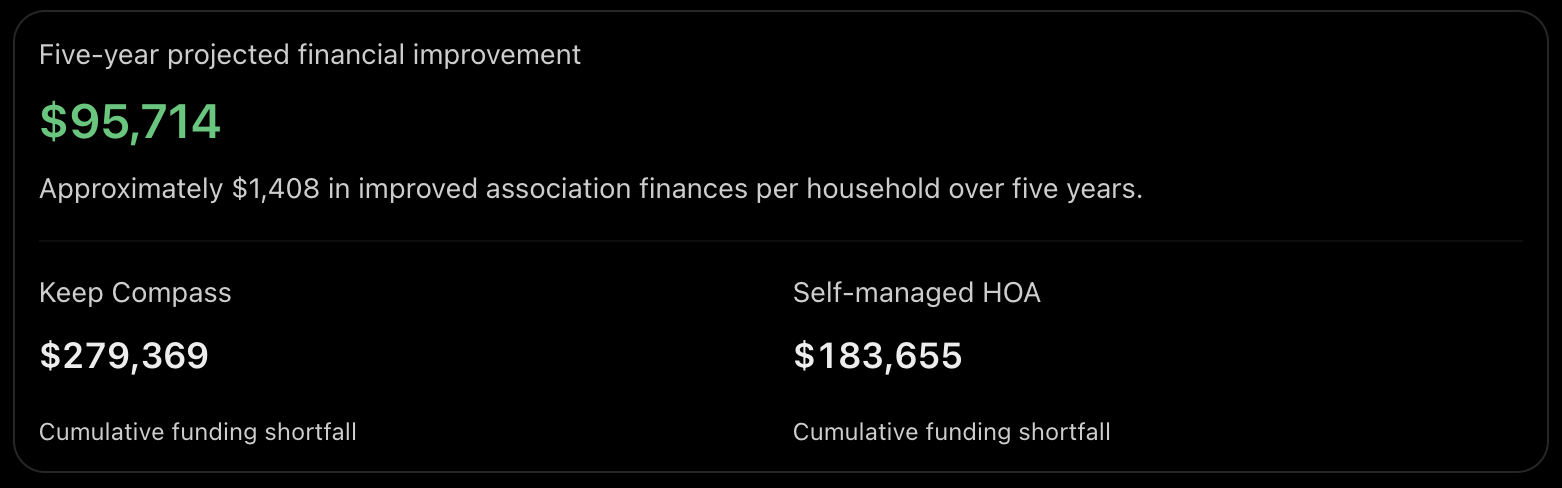
Using the revised insurance estimate, self-managing Rice Lake Terrace and compensating four board members could improve the association's finances by approximately $95,700 over five years.
This comparison assumes that we continue raising dues by no more than 10% annually, maintain the reserve study's recommended contributions, and keep the same landscaping arrangements in both scenarios.
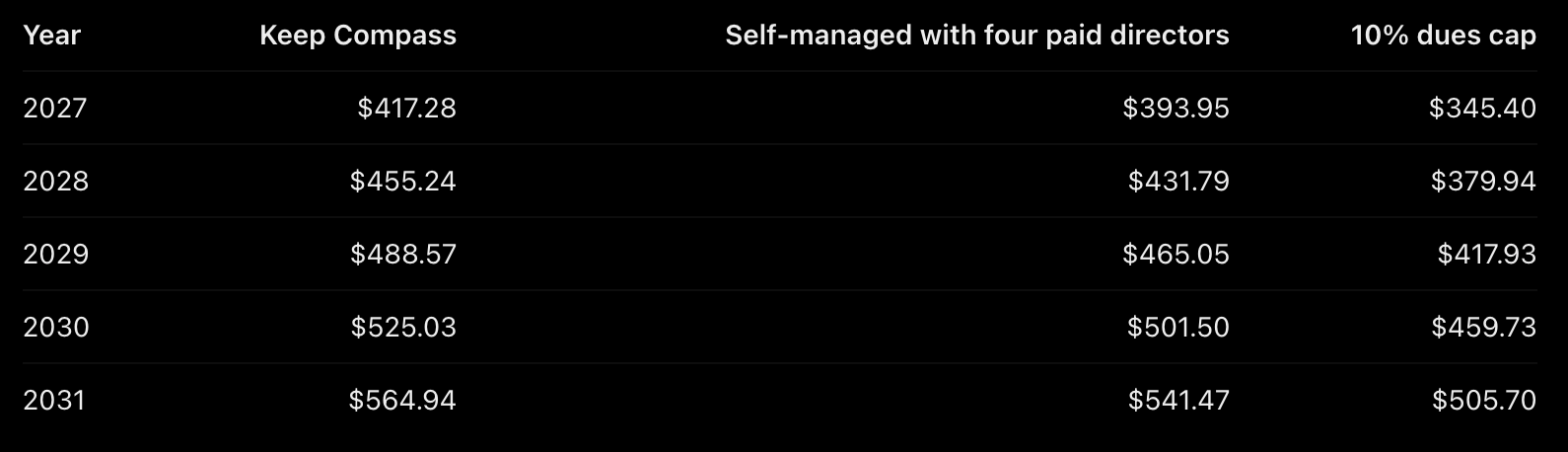
1. The monthly dues comparison
These figures represent the monthly assessments that would be necessary to fund the projected budget fully, including recommended reserves.
2. Annual funding shortfalls
This comparison measures the difference between the projected total funding requirement and dues collected at the 10% annual cap.
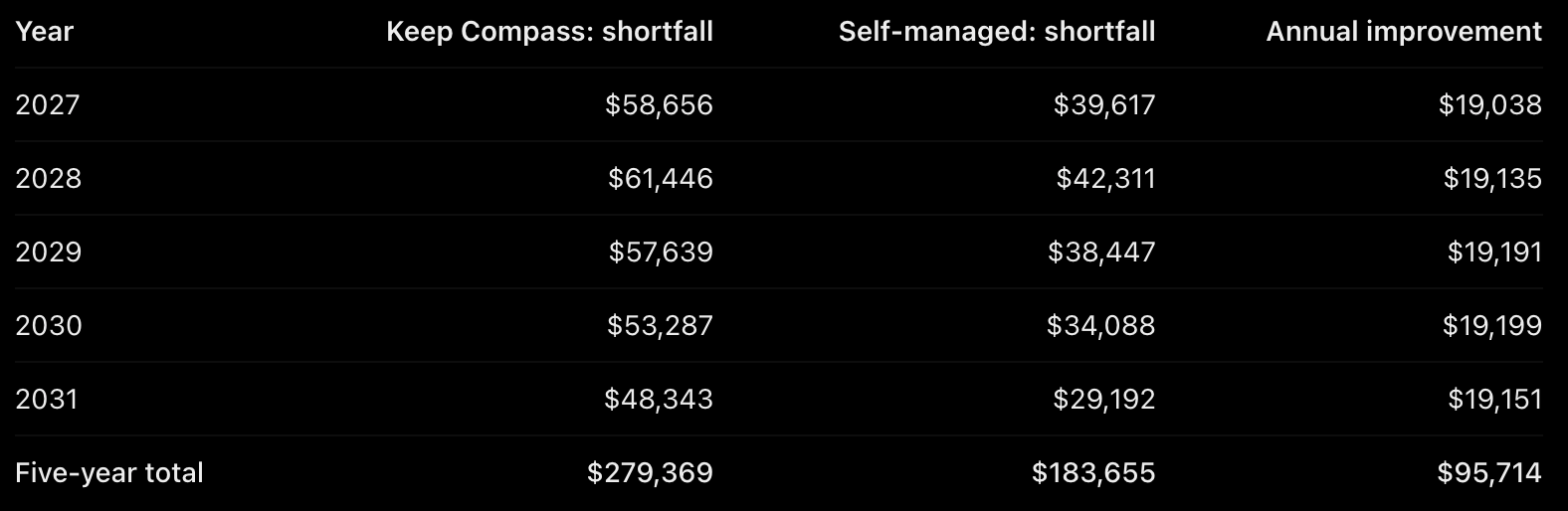
Rounded figures. These are gaps against full reserve-funding targets, not necessarily actual cash deficits.
3. Where the five-year savings come from
Financial change
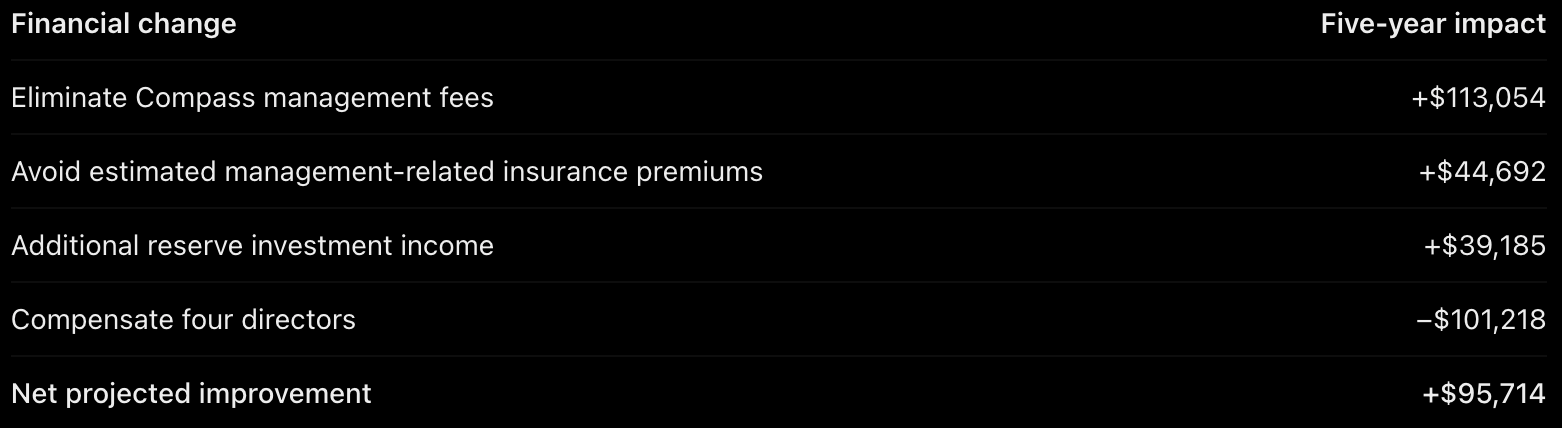
The insurance calculation now uses your revised assumption of $5,000 in 2023, compounded at 10% annually—not the previously assumed $15,000 every year.
The directors' compensation equals 12 monthly assessments for each of four directors, using that year's capped dues. All 68 homes remain responsible for assessments in this model.
Importantly, the management fee saving is more certain than the insurance or investment savings. The insurance amount is modeled rather than verified, and higher investment income requires achievable rates and sufficient invested balances.
4. The reserve study still matters
The original 2022 reserve study recommends:
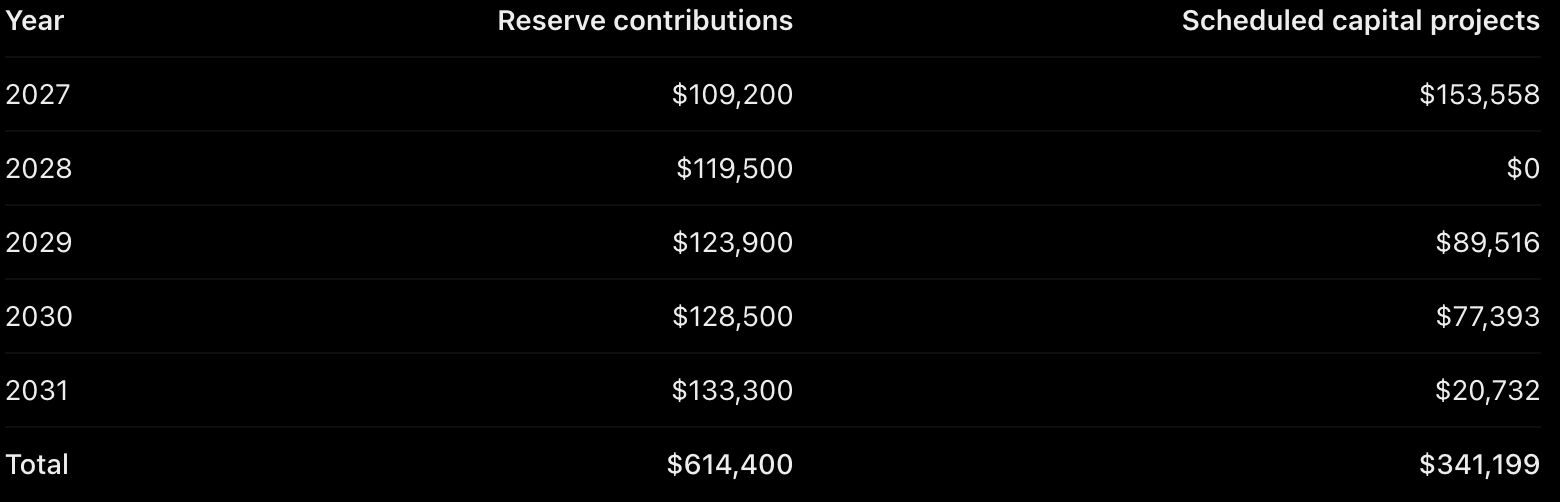
RLT Reserve Study 2022 (1).pdf
The financial comparison preserves these recommended contributions in both scenarios. The assumed additional interest reduces the contributions required from homeowners to achieve the same funding target.
However, the reserve study is from 2022 and does not reflect the September 2026 actual reserve balance of approximately $392,000, so the capital schedule and funding plan need updating.
1054047_2026_09 Owner Financials.pdf
5. What I would present to homeowners
Five Years. Nearly $96,000 in Potential Financial Improvement.
Rice Lake Terrace has 68 homes. Over the next five years, our association faces increasing insurance, maintenance, landscaping, and major repair expenses.
If we keep Compass Management and follow current expense projections, we could face a funding shortfall of approximately $279,000 between 2027 and 2031, even while increasing homeowner dues by 10% annually.
There is another option.
By managing the association ourselves, compensating four directors for their work, reducing insurance costs associated with professional management, and improving returns on reserve investments, we could reduce that projected shortfall to approximately $184,000.
That is approximately $96,000 in potential financial improvement over five years.
Our model includes compensation for all four board members and retains the reserve study's recommended contributions for future property repairs.
These are estimates, not guaranteed savings. Insurance reductions, investment earnings, and the costs of replacing management services must be verified before implementation.
The proposed change would not solve every financial challenge. It would allow us to direct more of our money toward our own neighborhood while providing compensation and accountability for the homeowners who perform the management work.