What the Fall 2026 Newsletter Leaves Out
A documented homeowner response to the Rice Lake Terrace Board + Compass Management newsletter | Homeowner Edition - not Board Member Edition | Newsletter pages 1–5
The newsletter presents selected repairs and a positive account of Compass’s performance. Homeowners also deserve to know what remains unfinished, which decisions have not been explained, and how current reserves compare with the Association’s own capital funding plan. This document separates written records from firsthand homeowner reports and issues remain questionable pending verification.
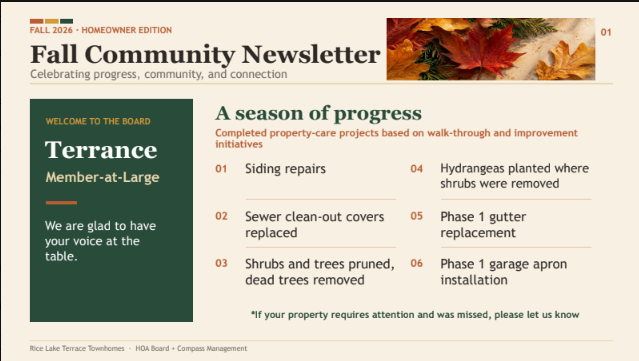
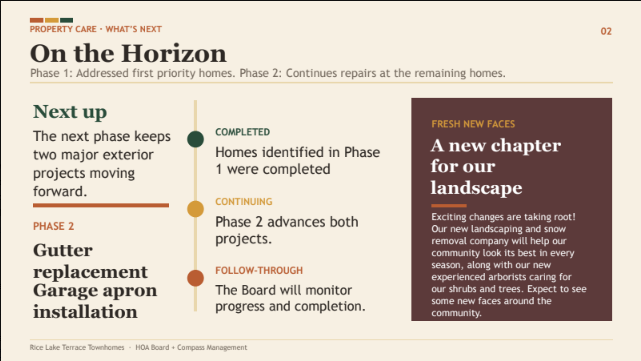
PAGES 1–2 | Work described as “complete” while problems remain
The newsletter lists siding repairs, sewer clean-out covers, landscaping, gutters and garage aprons as signs of progress. The 2026 Spring Walkthrough still identifies multiple siding defects, missing clean-out covers, cracked steps and landscaping needs. Notes such as “sent to MM on 6/8” show a referral—not proof that repairs passed an inspection or were closed out.
Newsletter theme → What homeowners should know
Siding and concrete → The 2026 walkthrough documents damaged siding and cracked/crumbling steps. No uniform completed-date or inspection field accompanies these findings.
Landscaping → A homeowner reports that some replacement shrubs have already died. The walkthrough identifies ongoing trimming and tree-removal needs. Compass was informed via contract when cleanup, trimming and seeding will take place
Gutters → The homeowner reports that the highlighted Phase 1 gutter work occurred in 2025, not 2026; the newsletter does not date that work.
Garage aprons → A former board president reports the program is at Phase 3, with Phase 4 and not completed this year. The amount list is more than previous bids and done by different contractors The newsletter describes Phase 1 and Phase 2 without reconciling the actual schedule.
Ignored (not listed) → The May 2023 walkthrough identified sinking aprons, concrete deterioration, damaged siding and extensive tree work. Some categories, and particular sites such as chimney deterioration, recur in the 2026 records. The 2023 problems predate Compass; the unanswered question is what was actually completed during its tenure.
New landscaping and contracts require an accounting
Page 2 announces a new landscaping/snow-removal company and arborists. The board should disclose the old and new contracts, any termination notice or penalty, and whether new services were authorized under the budget and governing documents. Reports of separate shrub-trimming payments or termination without notice remain unverified; they should not be represented as established facts but should be explored as personal board liability for vacating the 2/3rds vote required by the bylaws.
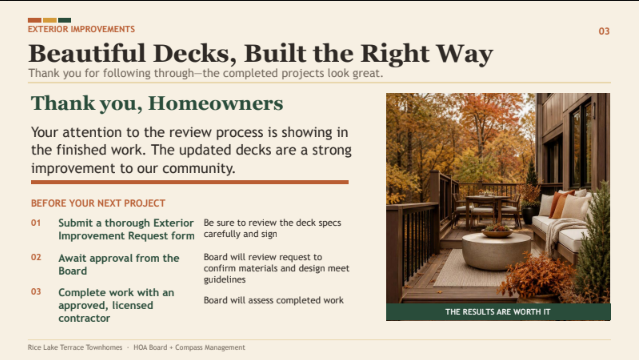
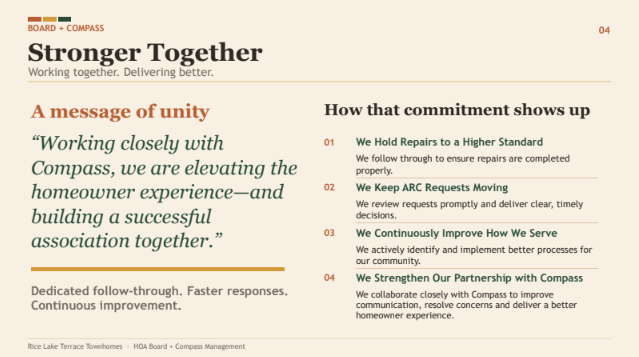
PAGES 3–4 | Architectural rules, inspections and accountability
ARC administration has repeatedly failed its own process
The newsletter instructs owners to submit complete forms, await a decision and use licensed contractors. But the management correspondence establishes failures on its side of the process: a 2024 deck submission was missed; September 2025 board notices went out without supporting attachments; October 2025 approvals were not consistently reflected in the management workflow; and a request was directed to an ARC committee that did not exist.
Earlier general improvement forms permitted owner-performed work, while the newsletter now presents an approved licensed contractor as mandatory. The board should identify the actual adopted deck rule and its effective date.
Different outcomes and missing final inspections
A homeowner reports that the 9209 deck application was not approved while the related shared deck for 9211 was approved; earlier applicants were not required to sign the same architecture/specification page; and completed decks with rounded spindles appear out of specification without final inspections. These are disputed factual concerns, and the board should publish the applicable standards, decisions and inspection records, with private homeowner details protected.
The former board president also reports that Compass was hired to inspect contractor work and that invoices have been paid without a final inspection. The decisive test is straightforward: for every paid job, match its contract, invoice, payment, signed acceptance and inspection record. Payment alone is not proof of satisfactory completion.
“Stronger Together” is not the same as independent oversight
Page 4 promises properly completed repairs, prompt ARC decisions, faster responses and better service. But homeowners have reported difficulty getting replies and have contacted the former board president for help. The 2026 walkthrough does not provide a consistent public closeout trail. In December 2025, directors themselves described dropped work and insufficient support capacity.
When management prepares the progress report, controls the portal and handles requests for source records, residents need meaningful independent oversight. A quoted $150-per-hour retrieval/redaction charge raises a practical barrier to checking the underlying financial and project records, although the permissibility of a particular charge requires review of law and contract.
Required proof of completion
· For each repair: date reported, bid, authorized scope, contractor, invoice, payment, inspection, and actual closed date.
· For ARC matters: adopted rules, board vote/approval date, portal decision, final inspection and any correction order.
· For contractor changes: procurement record, terminated contract, notice, replacement contract and cost difference.
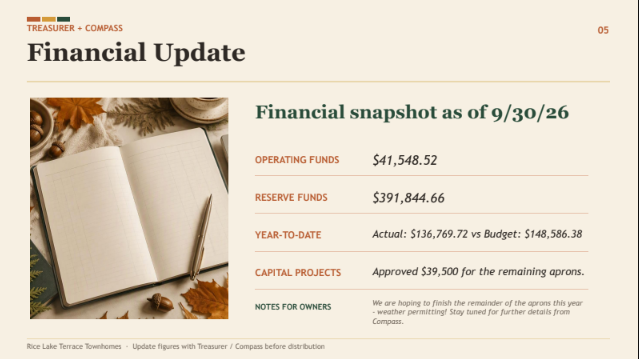
PAGE 5 | What the financial snapshot omits
The newsletter reports $391,844.66 in reserve funds on September 30, 2026, without comparing that figure to the 2022 reserve study’s recommended funding path. The study projected $540,163 in reserves at December 31, 2026. Comparing the two published figures gives a $148,318 gap—but the dates are three months apart. Using the study’s evenly paced contributions and no scheduled 2026 reserve projects gives an estimated September funding-path gap of approximately $123,600, not a certified loss or current special assessment.
Reserve measure → Amount / comparison
2022 study: projected Dec. 31, 2026 balance → $540,163
Newsletter: reported Sept. 30, 2026 reserves → $391,844.66
Different-date headline gap → ~$148,318
Estimated gap vs. Sept. 2026 study funding path → ~$123,600 (~$1,818 per home)
Study: recommended 2026 reserve contribution → $98,900
Approved 2026 budget: reserve transfer → ~$59,458
2026 annual reserve contribution gap → ~$39,442 (about 40% below recommendation)
The study assumed negligible interest and no reserve-funded capital expenditures in 2026. Actual reserve withdrawals, transfers and earned interest must be reconciled before anyone calls the projected-balance difference “money missing.” It is, however, a major gap between the original capital plan and the balance publicly reported.
Projects scheduled in the reserve study
The study scheduled asphalt crack work in 2023 and concrete flatwork, concrete stairs/landings, metal railings and a reserve-study update in 2025. Its original schedule did not call for complete gutter replacement until 2029, and it did not describe the board’s current four-phase garage-apron program. The 2026 walkthrough still lists concrete concerns; actual completion and project rephasing need verification.
Looking ahead, the study projected $153,558 in reserve expenditures in 2027, including approximately $97,855 for water and sewer laterals. The report also recommended updating the reserve study every two to three years. Without an updated study and full 2023–2026 reconciliation, the association cannot tell homeowners whether capital work and contributions remain adequate.
Financial mistakes are separate from the funding gap
The board approved $200,000 in CDs in August 2024; Compass later acknowledged the instruction “got missed,” and the investments opened at a lower annual yield. In December 2025, $13,870.02 belonging to another HOA was mistakenly paid and later refunded. A separate $6,631.68 invoice passed through a “Possible Duplicate” warning and void/reissue sequence; there is no proof of a permanent double payment. These incidents warrant examination, but the dollar values must not be added to the reserve shortfall as losses.
What Homeowners Should Demand Now
Pages 6–7 provide seasonal reminders and links to Compass, but they do not answer the financial and oversight questions. The board should provide a dated, verifiable report rather than asking homeowners to accept broad assurances of “progress.”
Six records that would settle the disagreement
· A 2023–2026 reserve reconciliation: opening balances, actual transfers, interest, capital expenditures, other transfers and closing balances, with the updated reserve study.
· A 2023–2026 project register showing original and revised schedules, phases, costs, completion dates and inspection sign-offs for concrete, gutters, siding and masonry.
· A payment-and-inspection audit for contractor invoices, including who approved each invoice and documented unfinished or defective work.
· The adopted ARC/deck standards, changes and effective dates, and a consistent record of approvals, denials and final inspections.
· The former and current lawn/snow contracts, termination notices, arborist agreements, separate landscaping invoices and corresponding board votes.
· A register of management errors, refunded payments, investment execution delays, fire-claim professional fees and pursued or abandoned third-party recoveries.
The question is whether Compass should continue managing Rice Lake Terrace
The documented reserve-funding divergence, admitted investment delay, erroneous insurance payment, recurring ARC breakdowns and unresolved inspection questions justify a formal, transparent review of Compass Management’s contract. The former board president advocates CANCELING the Compass Management contract. Members should be given the evidence, costs, termination requirements and a workable direct-management or transition plan before the board makes that decision.
This is a homeowner-authored rebuttal, not an official association statement, audit or finding of illegal conduct. Some observations are firsthand reports, not independently verified. A reserve funding gap is not the same as missing cash, and a vendor contract or alleged bylaw violation requires review of the actual governing documents.
Please call the former board president Travis Mitchell for more information 612.817.3036 if you would like to review any document at NO COST. The 2026 documents are not available. Compass has sealed them against financial restriction of $150 a hour to receive terribly redacted materials.
Documents underlying this response
Fall 2026 Board + Compass Newsletter (pages 1–5); RLT Spring Walkthrough 2026; Spring Walk Through Notes, May 23, 2023; RLT Reserve Study 2022, Funding Summary (report p. 1-1), 30-Year Cash Flow (p. 3-3), Years 1–5 (p. 3-4), and Life Analysis (p. 3-2); approved 2026 budget; relevant 2024–2025 ARC, banking, invoice and board correspondence. Request original records for verification.
Distribution note: The 2022 reserve study contains a restriction on reproducing or referencing its contents in third party-distributed materials without the preparer’s prior written consent. You can view it but I cannot print copies of it.